Display models: Brands are employing everything from augmented reality to non-fungible tokens.
Digital culture is transforming the way we display jewelry in the public realm, from gallery settings to storefronts. Pop-up models, experimental online spaces, and retrospective exhibitions are growing, hybridizing with art, technology and fashion to morph into something new. Immersive “phygital” environments have become a formula for capturing young consumers and digital natives.
Meanwhile, the extensive global lockdowns and store closures of the pandemic years have prompted a surge in demand for heightened emotional and exclusive experiences. New jewelry exhibitions have soared in popularity, bringing with them a wave of tech-centric, projection-based displays. Apps, hyperphysical stores, virtual try-on technology, multisensory exhibitions, and artificial intelligence (AI) permeate this space.
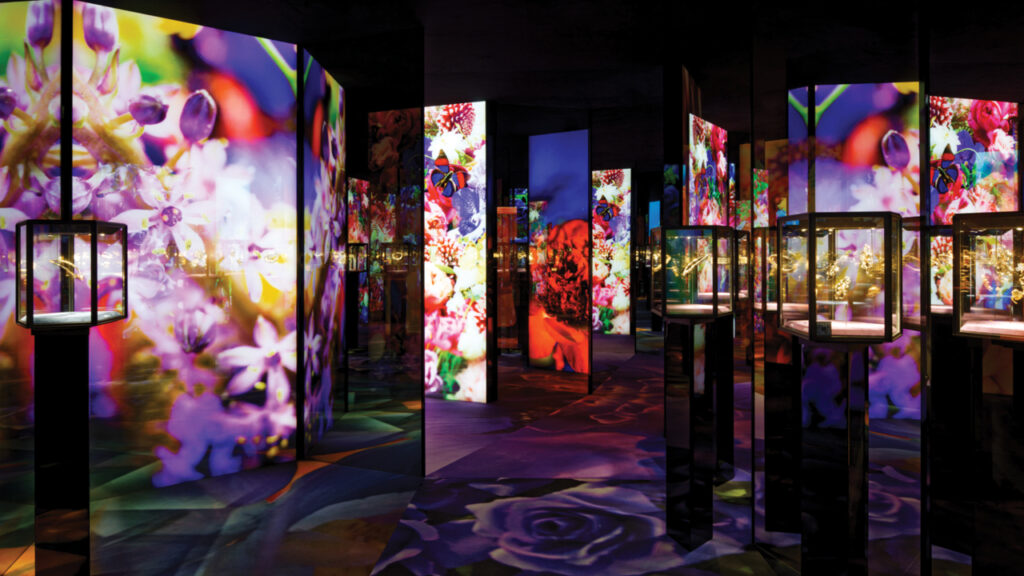
in Paris, curated by Van Cleef & Arpels.
Art and exhibition
“Today, it is only through art and emotion that we can communicate visions associated [with] a product, a company or a place,” says luxury analyst Paola De Luca, founder of trend-forecasting company The Futurist. And indeed, luxury brands’ dalliance with the art world is becoming increasingly customary.
Van Cleef & Arpels delivered the Florae exhibition in 2021, collaborating with photographer Mika Ninagawa and architect Tsuyoshi Tane to showcase the maison’s floral creations. Louis Vuitton’s “200 Trunks, 200 Visionaries” touring exhibition last year embraced art and the culture of video games, using digitalized effects, animation and audiovisuals to present the luxury house’s one-of-a-kind creations.
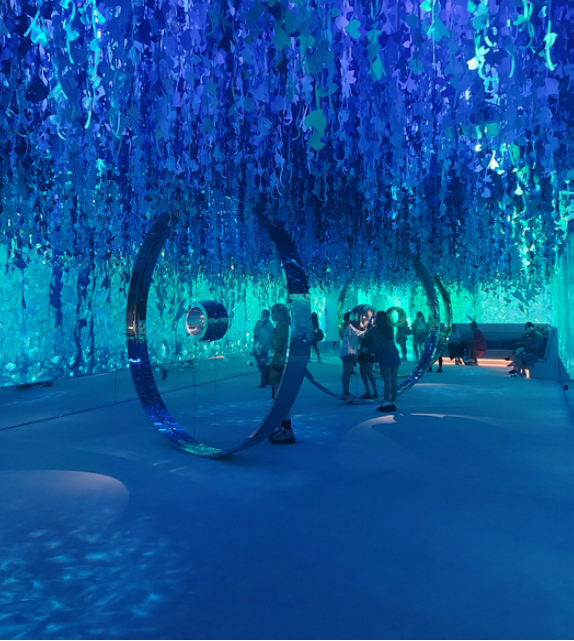
in London.
Tiffany & Co.’s “Vision & Virtuosity” exhibition in London last summer was designed to lend itself well to social media coverage, which the brand has embraced as a powerful marketing channel. Among other things, the Tiffany show harnessed augmented reality (AR) technology to let visitors digitally try on the iconic Tiffany Diamond necklace, and included interactive screens on the walls where attendees could write love notes and other messages.
These immersive exhibitions invite visitors to go beyond passively observing, making them active protagonists in the jewelry narrative.
Getting hyperphysical
The retail realm has also changed significantly. Following the pandemic, there was a rise in “hyperphysical” retail experiences in hopes of enticing luxury shoppers back into stores in 2022. High-end brands like Balenciaga, Jacquemus and Louis Vuitton have transformed their shops into multisensory art spaces of escapism and fantasy, driving social engagement in the form of Instagram and TikTok reels. While it’s predominantly luxury houses that have adopted this trend so far, there is potential for jewelry brands to do so as well.
Virtual vibes
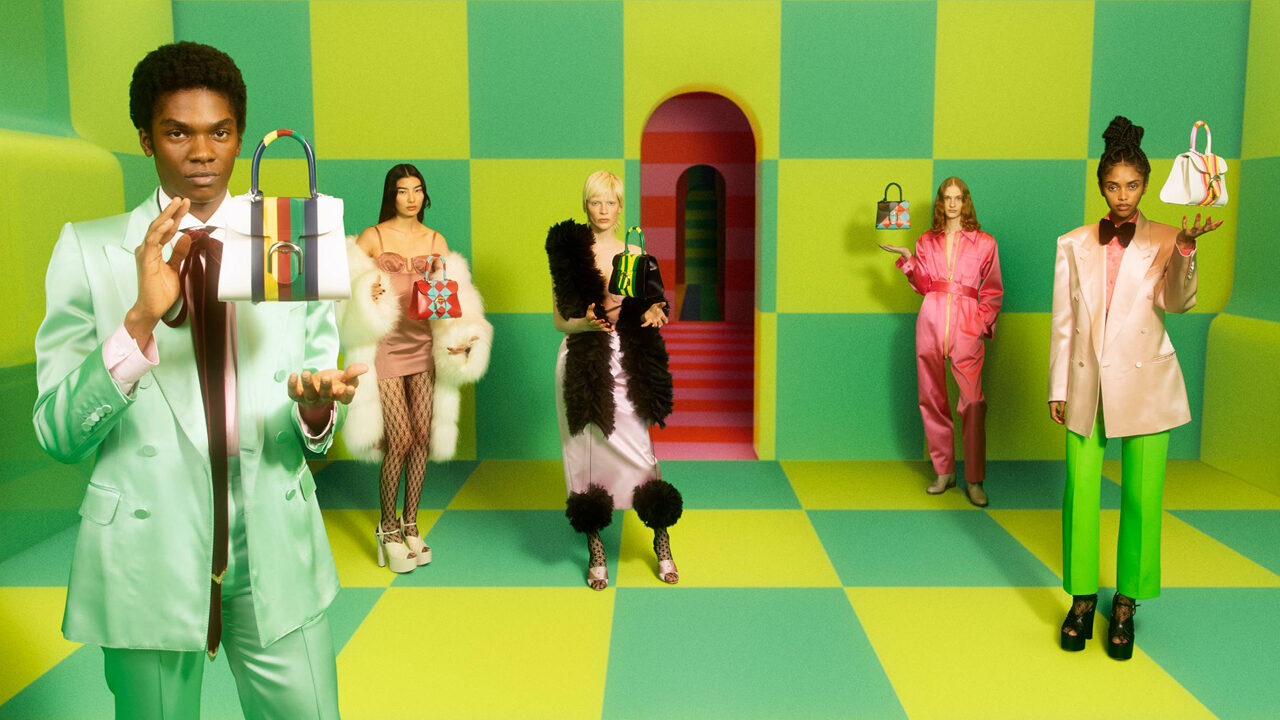
Beyond the physical, there’s been a rise in virtual jewelry displays. Gucci Vault, for instance, is an experimental digital space that takes users on a journey to discover the brand’s history through immersive storytelling, games and non-fungible tokens (NFTs).
The Shenzhen Jewelry Museum in China is collaborating with The Futurist to launch a debut exhibition in March titled “Joy of Color,” which will include a metaverse gallery. The exhibition — which features 20 international jewelry designers — “will express the incredible wave of color that started during the pandemic as a reaction to being imprisoned,” says De Luca.
The meta-space, she adds, is changing the dynamics between creativity and products. “The emergence of Web 3.0 triggered the attraction to digital platforms, and the parallel world of gaming really intensified, which has inspired consciously and unconsciously a new [means] of expression.”
Innovation the old-fashioned way
Not all jewelry displays utilize technology to achieve a dramatic and immersive art experience. Flagship boutiques and concept stores like Patcharavipa, Objet d’Emotion, and Elisabetta Cipriani are breaking the traditional mold of jewelry stores.
Visiting the Patcharavipa flagship in Bangkok, Thailand, you could be forgiven for thinking you’d stumbled into a contemporary art gallery, complete with media installations and sleek decor. Designer Patcharavipa Bodiratnangkura has put thought not only into the jewelry, but into every tactile surface in the store, bringing the brand’s brutalist vision to life with foam displays that evoke cold, industrial concrete.
In choosing the material for the display cases, she relates, “I wanted something that could protect the precious jewels but also be soft and easy on the skin. Foam was an exciting material to play and work with. There’s a shock element when visitors realize the foam texture of the cabinet. It’s surprising and unexpected, and we want to convey this message.”
In 2021, Valery Demure introduced Objet d’Emotion in London, inviting customers to “get intimate” with jewelry. Demure took every element into account, from the physical arrangement to the viewer experience. The cabinets contain a mix of designers and styles to show clients how they can tastefully combine their jewels. “I thought about my dressing table and how jewelry is lying on it with different pieces, styles and sizes,” she explains. “The cases compliment our ever-changing curations, and the concept of mixing jewels and designers is definitely fresh and groundbreaking.”
Cover image: The Gucci Vault uses immersive storytelling, games and NFTs to engage shoppers. (Gucci)